
Improving, Not Moving: Extending Your Home in Rural Swansea

House extensions Swansea
If you’ve lived in West Wales for any length of time, you know that the landscape is as much a part of your home as the walls themselves. But as families grow, that idyllic rural cottage or semi-rural villa can start to feel a bit tight.
By 2026, the trend of "improving, not moving" has firmly taken hold in Swansea. People are choosing to invest in their current postcodes rather than battling a volatile housing market. However, extending a property in a rural setting isn't just about adding square footage; it’s about making sure that new space doesn't look like an alien block dropped into the Welsh countryside.

The Rise of Biophilic Design in West Wales
One of the most effective ways to ensure a house extension feels natural is through biophilic design. It sounds like a buzzword, but in reality, it’s just a return to using natural materials that "breathe" with the environment.
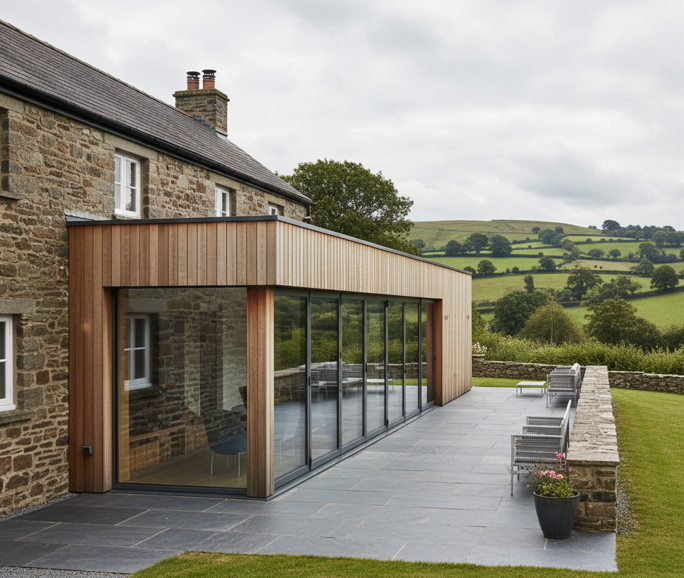
When we look at house extensions in Swansea, especially in areas bordering the Gower or the valleys, we’re seeing a shift away from render and brick. Instead, local stone and timber cladding are becoming the go-to choices. Timber, in particular, weathers over time, turning a silvery grey that matches the Welsh sky and sits quietly against a backdrop of trees. Using these materials means your extension looks less like an addition and more like a natural evolution of the site.
Navigating Planning for Larger Footprints
Planning permission is often the biggest hurdle for rural homeowners. Swansea Council can be protective of the local landscape—and rightly so. If you’re looking at a larger footprint, the key is often to demonstrate "visual subordination".
This basically means the extension shouldn't overwhelm the original house. We often advise clients to keep the roofline of the new section lower than the original building. It’s a small design trick, but it makes the planners much happier because the character of the primary dwelling is preserved.
The Modern "Wraparound": Creating Indoor-Outdoor Flow
If you have the space, the "wraparound" extension is currently dominating UK architectural trends. By extending both to the side and the rear, you create an L-shaped living area that can completely transform the ground floor.
The real magic here is the indoor-outdoor flow. Large bifold doors or floor-to-ceiling glass panels allow you to frame the views of the garden or the rolling hills beyond. In a rural Swansea home, your garden is often your best asset. A well-designed extension should act as a bridge between your sofa and the great outdoors, making the house feel twice as big even when the doors are shut.
Practical Realities of Rural Building
It’s worth mentioning that building in rural areas comes with its own set of logistical headaches. Access for heavy machinery can be tricky on narrow lanes, and drainage often requires more thought than a simple connection to a main sewer. These aren't dealbreakers, but they are things you need to account for in your budget and timeline from day one.
Extending your home is a big commitment, but in a location as beautiful as Swansea, it’s usually the right one. By focusing on materials that respect the landscape and a design that prioritises the view, you can create a space that feels like it was always meant to be there.


Comments